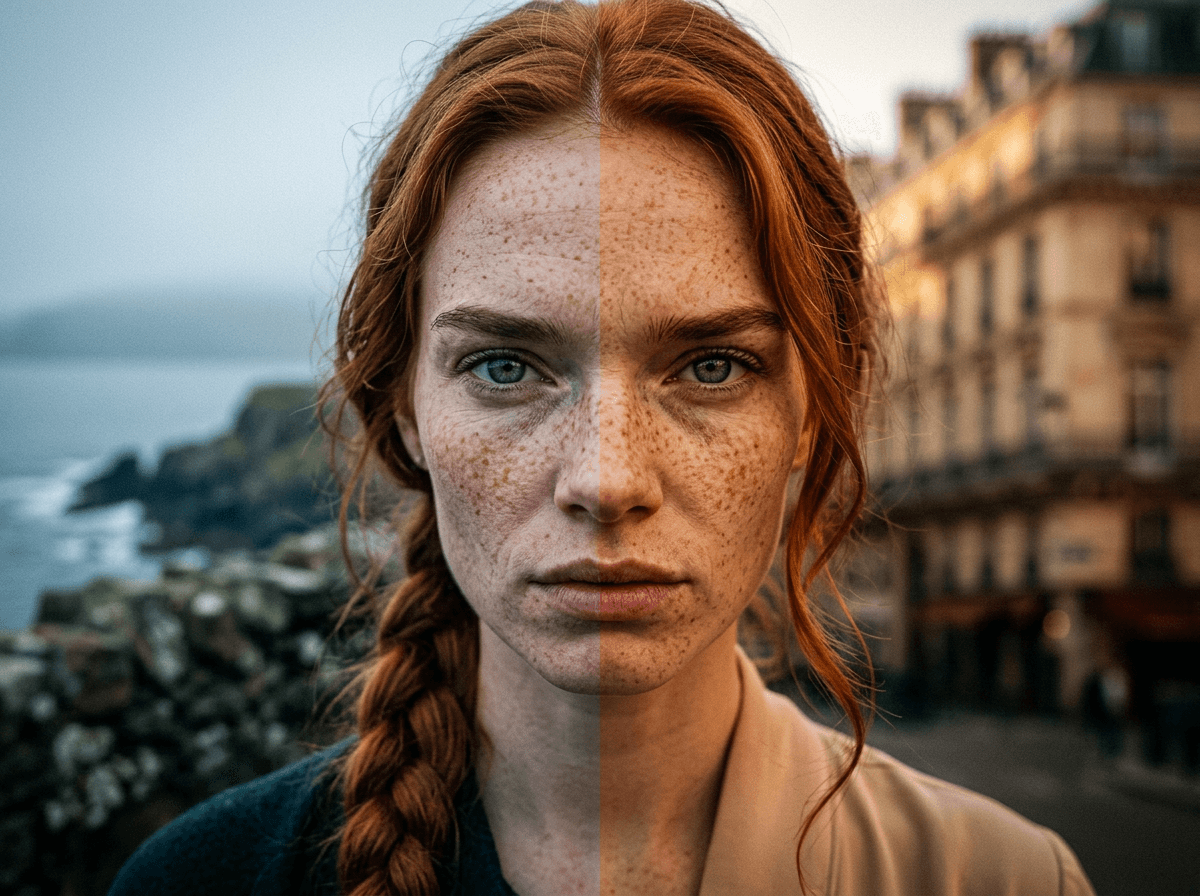
A fiercely independent Scottish sheep farmer inherits a French fortune and must navigate the treacherous waters of Parisian high society while a charismatic aristocrat challenges everything she thought she wanted—including her right to remain unchanged.
Twenty-eight-year-old Màiri MacLeod has spent her entire life on the windswept Isle of Skye, tending her modest flock and living by the honest rhythms of rural Scotland. When a Parisian notary arrives with news that her estranged French grandmother—a woman she met only once as a child—has died and left her a staggering fortune including a historic hôtel particulier in the 7th arrondissement, Màiri's carefully constructed life fractures. The inheritance comes with conditions: she must spend six months each year in Paris managing the family's cultural foundation, attend society functions, and preserve the Beaumont legacy. Torn between loyalty to her Scottish roots and curiosity about this glittering foreign world, Màiri reluctantly enters Parisian society, where she's viewed as an amusing novelty—a shepherdess playing dress-up. Enter Étienne de Sainte-Croix, a devastatingly charming art dealer from an old aristocratic family who seems to embody everything Màiri distrusts about inherited privilege. Yet Étienne sees past her awkwardness to the fierce intelligence beneath, while Màiri discovers that his polished exterior hides his own conflicts about duty versus authenticity. As she's pulled between her pragmatic Scottish aunt who urges her to sell everything and return home, her ambitious French cousin who wants to modernize the foundation, and her own growing attachment to both worlds, Màiri must forge a new identity. The series explores whether it's possible to honor two opposing cultures, or if choosing one means betraying the other—and whether love can exist between two people from worlds that were never meant to touch.

Màiri's aunt speaks in absolutes with the certainty of someone who has survived by making hard choices and never looking back, her pragmatism a shield against the sentimentality that might make her question those choices. She believes the world is divided into people who face reality and people who indulge in fantasy, and she has spent her life firmly in the former camp, even when it cost her happiness. Her gruff exterior hides a fierce protectiveness, but she shows love through criticism and practical help rather than affection, convinced that preparing people for disappointment is the kindest thing she can do.

Màiri moves through the world with the quiet competence of someone who has always relied on herself, suspicious of anything that comes without honest work behind it. She possesses a sharp, observational intelligence that reads weather patterns and sheep behavior as fluently as others read books, but this same directness makes her awkward in social situations that require performance or pretense. Beneath her practical exterior lies a deeply romantic soul she's learned to suppress—she reads poetry by the peat fire and dreams of places she's never allowed herself to want.

Lachlan carries himself with the quiet authority of someone deeply rooted in his community, his world bounded by the island's shores in a way he considers wisdom rather than limitation. He represents everything familiar and safe in Màiri's old life—steady, predictable, fundamentally decent—but also everything she's beginning to realize she's outgrown, though neither of them wants to admit it. His love for Màiri is genuine but possessive, born from the assumption that they've always been meant for each other simply because they've always been together, and he interprets her inheritance as a test of her loyalty rather than an opportunity for her growth.

Étienne wears his charm like a perfectly tailored suit—so naturally that most people never see the calculated effort behind it—but his real passion emerges only when discussing art, when his careful social polish cracks to reveal genuine intensity. He's spent his life performing the role of the cultured aristocrat while privately despising the emptiness of inherited status, drawn to creators and makers with an almost desperate hunger for authenticity. Behind his ease in every social situation lies a profound loneliness, the isolation of someone who has never been allowed to simply be rather than represent.

Sylvie has spent her entire life as the dutiful Beaumont granddaughter, managing the foundation with competent precision while watching the inheritance she expected pass to a stranger who doesn't even want it. She masks her resentment behind professional courtesy and helpful guidance, but every interaction carries the weight of comparison—she is polished where Màiri is rough, knowledgeable where Màiri is ignorant, and yet somehow insufficient in the eyes of her grandmother's will. Her need for control manifests as helpful micromanagement, offering advice that subtly undermines while appearing supportive, driven by a genuine belief that she would preserve the legacy better than this Scottish interloper.

Philippe moves through Parisian society with the weary cynicism of someone who has seen three generations of wealthy families make the same mistakes, his role as notary giving him an intimate view of how money corrupts relationships and inheritance destroys families. He maintains scrupulous professional boundaries while privately rooting for the underdogs and outsiders, drawn to Màiri's authenticity in a world of performance and positioning. Behind his dry legal precision lies a romantic who still believes that occasionally, someone might use wealth for something meaningful rather than simply perpetuating privilege.