

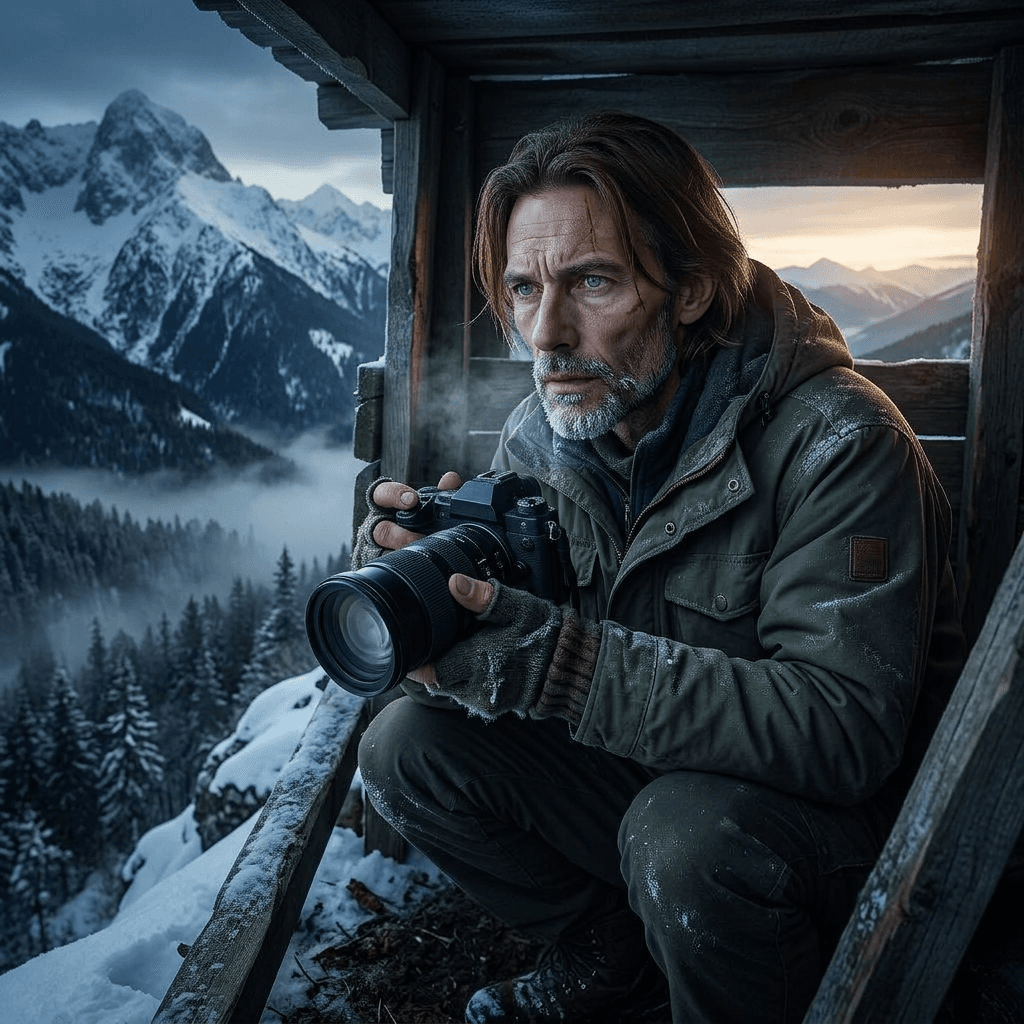
Wild - Episode 1: The Wait
Act 1: The Lynx's Territory
Darkness tears slowly apart. The Carpathians emerge from night like sleeping creatures, their flanks covered in pristine snow that absorbs every sound. Mathis Verlaine has been here since before dawn, huddled in a makeshift blind—interwoven branches, gray canvas—perched fifteen meters above the ground. His hands have become foreign objects, swollen and numb despite three layers of gloves. He can barely feel his face.
But his eye remains alive. Hypervigilant.
Through the 600mm lens, the world reduces to a window of perfection. Freshly fallen snow, smooth as glass. The tracks—two of them, maybe three—crossing the clearing below. Lynx prints. Not wolves. Not foxes. Him. The one he's been waiting for seventy-two hours.
The cold is not an enemy to Mathis. It's an ally. Cold makes animals predictable. Cold forces them out, to hunt, to show themselves. Cold separates patient observers from dilettantes. And Mathis Verlaine is not a dilettante.
A sharp crack cuts through the forest—a branch giving way under frost's weight. Mathis remains perfectly still. Forty-three minutes without moving. His muscles scream silently. He ignores the screams.
Somewhere in his skull, an image surfaces without warning. A Parisian studio, photos hanging on walls, hands trembling while holding a framed print. A life before, when he still believed photography was an act of sharing and not of flight. He hunts down the image with the same rigor he hunts animals. Mercilessly. Methodically.
Day declines. Late afternoon's golden light transforms the snow into a cathedral. This is the moment. This is always the ideal moment, three hours before dusk. Photographers know it. Lynx do too.
He doesn't come.
At 4:47 PM, Mathis packs his equipment. His movements are those of an ancestral ritual—each gesture in its place, each object knowing where to go. He extracts his worn notebook, its pages already filled with notes from the previous two days. The handwriting is tight, almost calligraphic.
"Day 3. Fresh tracks. Direction east-northeast. Territory marked at 200 meters. Cautious behavior. Will return."
He may not return. But Mathis writes as if the world obeyed logic. As if waiting always paid off. As if patience were a virtue and not a disease.
Act 2: The Intrusion
Dawn arrives without warning, as it always does in the mountains—first a milky gray, then a growing pallor, then finally day imposing itself without particular beauty. Mathis is already outside, his blind already in place, his equipment already checked. He slept three hours. It's enough.
The forest at this hour is a cathedral of silence. Not a sound. Not a movement. Just the weight of cold and the green immensity of firs. Mathis breathes through his mouth so his breath won't freeze in front of the lens. He's focused the way one is only in prayer or war.
That's when the sounds arrive.
Crunch. Crunch. Crunch.
Footsteps. Clumsy. Loud as a marching band in a museum. Someone who doesn't know how to walk in snow, who doesn't know that each step resonates through the forest like a scream.
Mathis closes his eyes. Just for an instant. Long enough for the world to shrink.
The silhouette emerges between the trees—a woman, too lightly dressed, her Parisian clothes protecting nothing. An urban backpack. City shoes. And around her neck, like a broken talisman, a camera that even Mathis can see, at this distance, is dead.
She sees him. He sees her. Their gazes cross in the gray light of dawn.
"Oh my god, sorry, I... You're a photographer? That's fantastic! Listen, I have a major technical problem with my camera and..."
Léna Kovacs speaks too fast, with the desperate energy of someone who needs to fill the silence before it devours her. Her words tumble out, without grammar, without logic. Mathis barely listens. He mostly hears what she doesn't say—the panic beneath the surface, the flight, the despair packed like an overstuffed suitcase.
"I can pay, really, I have... well I had... Shit, what exactly are you doing? Wildlife? Is this for National Geographic?"
Mathis responds in monosyllables. Yes. No. I don't know. And meanwhile, he packs his equipment. Each gesture is a silent reproach. Each movement says: you've ruined everything.
"No no wait! I'm just looking for the nearest village, I've been completely lost since yesterday and..."
She realizes too late that she's committed an error she can never recover from. Her voice drops.
"Oh. You were in the middle of... I screwed everything up, didn't I?"
Mathis descends toward his van. Léna follows, because she has nowhere else to go. The silence between them is a living animal, breathing and growing.
Act 3: The Refuge Van
The van's interior is a geography of solitude. Every object has its place. Every place has its meaning. The photos—dozens of them, pinned without frames, without apparent hierarchy—cover the walls. Wolves, bears, eagles, lynx. Creatures captured in their truest, wildest moments. No photos of people. No portraits. No trace of domesticated humanity.
Mathis lights the small gas stove. Coffee bubbles. He drinks a cup without sugar, without milk, sitting on the narrow bed that occupies half the interior space. Léna observes, fascinated and terrified by this minimalist existence.
"Wow, this is... super organized. You live in here?"
Mathis doesn't answer. He finally agrees to take her to Brașov, the nearest city, two hours away. Léna manipulates her broken camera, turning it in her hands like a cursed object.
"Dead sensor. Completely fried. You don't know a repair shop around here?"
She mentions she can pay any price. Mathis notices she's not wearing a wedding ring but a pale mark circles her left ring finger. He asks nothing. The engine refuses to start. Frozen battery. They're stuck until it thaws—at least six hours.
"Six hours? Okay. Cool. We're gonna... get to know each other, I guess?"
The silence becomes unbearable for Léna, heavy but familiar to Mathis. She keeps talking, filling every void with her words.
Act 4: Cracks
To escape the van's proximity, Mathis goes out to check the solar panels and battery condition. Léna follows him, unable to bear the silence. She talks about Paris, about her work as an architect, building words like walls against the cold and discomfort.
"Paris is crazy for architecture, but nature-wise it's a total zero. I spent my life drawing buildings, calculating structures, and now I..."
She stops. Then, as if the words escaped her:
"I was supposed to get married four days ago."
Mathis stops. First real connection—he finally looks at her. Léna realizes she's said too much, but she continues, the floodgates open.
"Viktor... it's complicated. Very complicated. My mother too for that matter. Power couple from hell."
Mathis points to a print in the snow—the lynx passed near the van during the night. Moment of shared grace: they follow the tracks together in silence. Léna finally sees what Mathis sees—the raw beauty, the presence of the invisible.
"He was here? Last night?"
"Yes."
For the first time in days, she doesn't speak. They return to the van. Léna's phone vibrates—twelve missed calls, threatening messages piling up like accusations. She turns it off definitively, the gesture as final as a falling blade.
"There. No more GPS, no more maps, no more connection. I'm officially lost."
Mathis understands she doesn't want to go to Brașov. He says nothing, but doesn't chase her away either.
Act 5: The Silent Decision
Night falls. The battery is recharged. Mathis could leave, drop Léna in town as planned. Instead, he prepares two bowls of hot soup. They eat without speaking, sitting on the van's running board under a dizzying starry sky. The constellations shine with that intensity only mountains know, far from cities, far from light pollution.
"How long are you staying in the region?"
"Two months. Maybe three. I'm following the wolves to the Abruzzi."
"You always travel alone?"
"Always."
Long silence. Léna sets her empty cup on the running board.
"I have nowhere to go. Really nowhere."
Mathis doesn't respond immediately. Then, without looking at her:
"Until the next town. After that, you decide."
It's not an invitation, but it's not a refusal. Léna nods, unable to speak. In the distance, a wolf's howl crosses the night—a primal sound, ancient, seeming to come from the dawn of time.
Mathis stands, takes his camera. Léna watches him leave into the darkness. She doesn't follow this time. She stays near the van, watching the forest swallow him.
For the first time in a long while, she's not running. She's waiting.
In the shadow of the trees, Mathis photographs without really seeing. He thinks about the choices that led to this solitary mountain. He thinks about the woman sitting near his van. He thinks he's just made a mistake. Or maybe not.
The lynx finally appears in his lens—perfect silhouette, eyes shining like emeralds in the night. The moment Mathis had been waiting for four days. The moment that would justify the solitude, the patience, the suffering.
He places his finger on the shutter.
He doesn't take the photo.
And in this gesture of abstention, something shifts definitively.