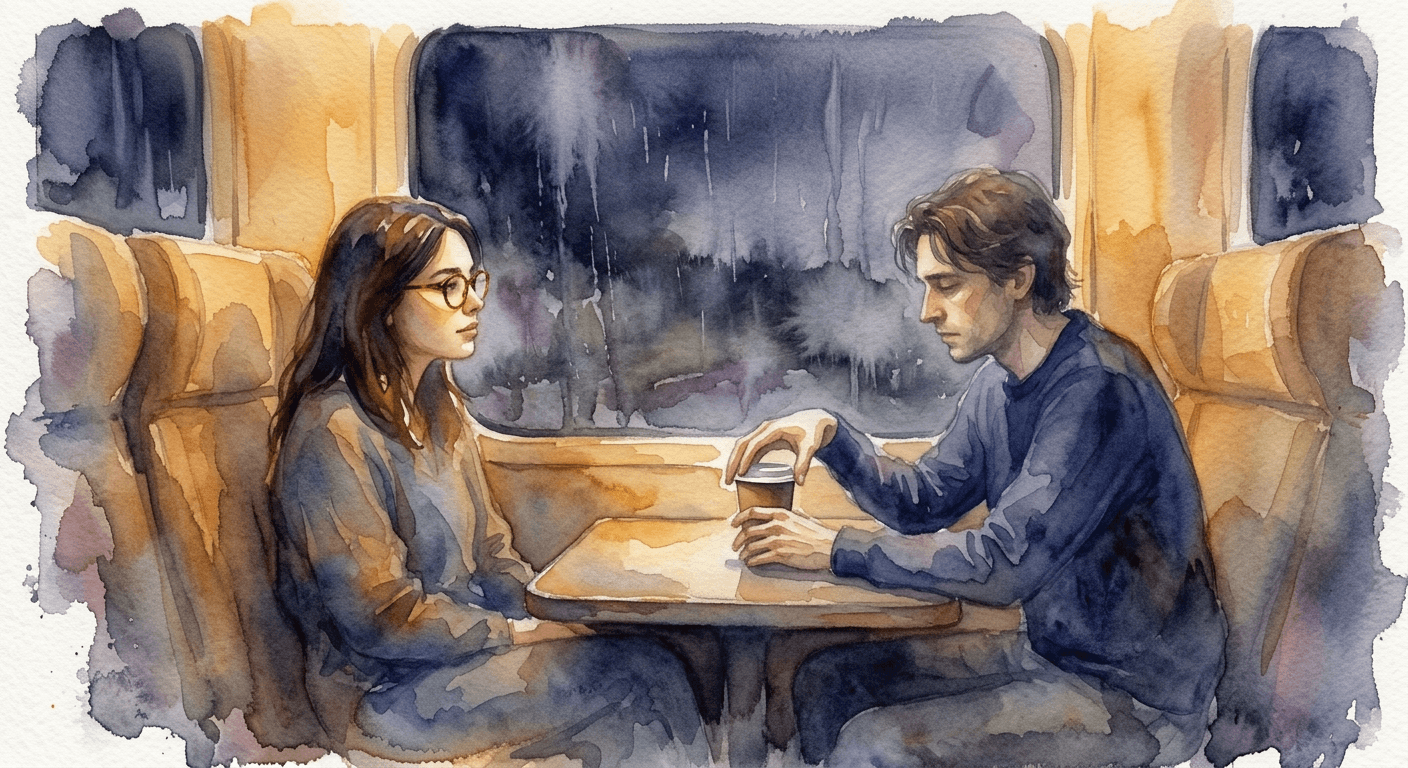
Two wounded souls find solace in weekly late-night train conversations, building an intimate connection through shared stories—until the ghostwriter discovers the memoir she's crafting belongs to the surgeon's ex-wife, and every word she's written has been drawing them closer to a betrayal neither can escape.
Every Friday at 11:47 PM, Dr. Adrian Holt boards the last northbound train from St. Pancras, carrying the weight of lives he couldn't save. Maya Chen sits in the same carriage, laptop glowing with other people's love stories, translating messy interviews into polished memoirs for clients she never meets. Their first conversation happens by accident—a spilled coffee, a shared napkin, an unexpected laugh in the fluorescent gloom. What begins as anonymous comfort between strangers evolves into the most honest relationship either has ever known, precisely because it exists outside their real lives, confined to those fifty-three minutes between London and Cambridge every week. Adrian talks about the impossible choices of emergency medicine, the patients who haunt him, the marriage that collapsed under the weight of his devotion to saving others. Maya shares her ghost-life, how she's become so skilled at inhabiting other people's emotions that she's forgotten her own. They create rules: no last names, no social media, no meeting outside the train. The carriage becomes their confessional, their therapy, their slowly-kindling romance. But Maya's latest client—a woman writing about loving and leaving a brilliant surgeon who chose his calling over their marriage—begins to sound devastatingly familiar. As Maya pieces together the truth, she faces an impossible choice: reveal herself and destroy the trust they've built, or continue writing the story that's already written their ending. The memoir's final chapter approaches, and with it, a deadline that will force both Adrian and Maya to confront whether the connection they've found in transit can survive the collision with their stationary lives.


Adrian moves through the world like a man underwater—present but muffled, connected to everything through a medium that distorts and slows. He's developed the surgeon's necessary distance from suffering, but unlike his colleagues who leave it in the operating theater, he carries every loss home with him, a collection of ghosts he can't stop counting. The train conversations with Maya are the only place he's allowed himself to be anything other than competent, and it's both terrifying and addictive—like finally breathing after years of holding his breath.

Samir has the rare gift of being genuinely content—he loves his work, loves his regulars, and has cultivated a life of small pleasures and meaningful routines. He's the kind of person who remembers everyone's order and asks follow-up questions about things mentioned in passing three weeks ago, not because he's nosy but because he's actually interested. He's watched Maya deteriorate into her ghostwriting cocoon over the years and has appointed himself her unofficial life coach, offering unsolicited advice with such warmth that it's impossible to be annoyed.

Eleanor has the psychiatrist's gift for seeing through performances, which makes her both an excellent therapist and an exhausting person to be married to—she can't turn off the analysis, can't stop diagnosing the dysfunction even when she's part of it. She left Adrian not out of cruelty but out of survival, and she's spent the eighteen months since trying to write herself into understanding through the memoir Maya is crafting. Writing about loving Adrian from a distance has made her realize she might still love him, but she's too proud and too hurt to admit the memoir is as much about reconciliation as it is about closure.

James is the colleague everyone relies on but nobody really knows—the senior consultant who's seen every kind of trauma and somehow maintained both his competence and his humanity, though Adrian suspects it's cost him more than he admits. He's become a reluctant mentor to Adrian, recognizing in the younger surgeon his own dangerous tendency toward martyrdom, and he's trying to save Adrian from the same fate without directly confronting him, because that's not how men of their generation and profession communicate.

Maya has spent so long channeling other people's voices that her own has become something she performs rather than inhabits—careful, accommodating, always finding the perfect words for someone else's feelings while her own remain unexamined. She's developed an almost supernatural ability to disappear into a room while simultaneously observing everything, a professional empathy that's become a shield against actually being vulnerable herself. There's a hunger in her for connection that terrifies her, because the only way she knows how to be close to people is by becoming them, and she's not sure there's anything left underneath all those borrowed selves.