

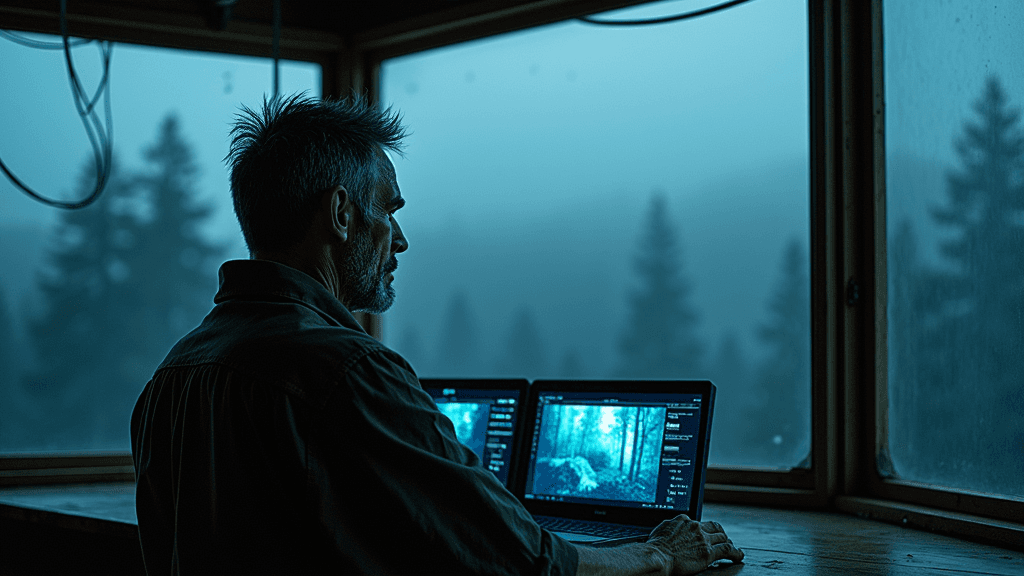
The morning mist clung to the Cascade Mountains like a living thing, filtering the dawn light into something almost sacred. Marcus Webb sat motionless at his workstation, three monitors casting their blue glow across weathered features. The fire lookout tower he'd converted into a surveillance hub rose above the old-growth forest like a technological intrusion—all glass and aluminum and fiber-optic cables snaking through a structure built a century ago to watch for fire.
Now it watched for other things.
"Third day running the same patrol route," Marcus murmured to the empty room, his fingers dancing across a mechanical keyboard with the precision of a concert pianist. "Alpha female's favoring her left rear paw. Old injury or new stress fracture from the rockfall last week."
The wolf pack moved through the forest below with the elegant inefficiency of creatures that had never needed to optimize. Marcus's algorithms tracked them anyway, measuring every deviation, every behavioral shift, translating the language of survival into data points and probability matrices. This was his life's work: the art of observation without interference, the science of watching without disturbing. Five years of perfecting it. Five years of isolation that felt, most days, like the only honest way to live.
Then the Hindu Kush feed registered an anomaly.
Marcus's eyes flicked to the secondary monitor—the one dedicated to comprehensive environmental surveillance in the high mountains of Afghanistan. His system wasn't designed exclusively for wildlife; it captured all acoustic and thermal data within monitored habitats, a necessity for detecting poaching operations and human encroachment on endangered species territories. The algorithm had flagged the audio as background noise, environmental interference below the threshold of significance. But Marcus had trained himself to listen to what the machines dismissed. He pulled the file, ran the audio through translation software, and felt his stomach drop like a stone into still water.
Pashto. Men speaking Pashto about timelines and coordinates and attack vectors.
He listened three times through, each repetition making the words more real, more immediate. The algorithm didn't distinguish between the call of a snow leopard and the planning of mass murder—both were just data, just patterns to be observed and recorded.
Marcus stood abruptly, pacing the tower's confined space. His hands trembled. Not from fear, but from the recognition of a choice he couldn't unmake: he had seen something he wasn't supposed to see. Observation without intervention—that was his philosophy, his ethical framework for five years. But this wasn't a wolf pack. This was human violence, premeditated and distant, but real.
He sat back down. Pulled up the audio again. Listened to the voices discussing what sounded like an attack timeline. His fingers hovered over his secure phone for twenty minutes. Then he set it down.
What was his responsibility here? He was a conservationist, not a counterterrorism analyst. The audio could be misinterpreted. His translation software could be wrong. The coordinates could refer to something entirely different. He told himself these things while knowing they were rationalizations.
He worked through the afternoon, trying to focus on the wolf migration data, but the Pashto voices kept echoing in his mind. By evening, he'd convinced himself that reporting through official channels would compromise his work, expose his surveillance infrastructure, invite government scrutiny that would destroy five years of careful relationship-building with the conservation community.
That night, he didn't sleep.
By the next morning, Marcus had rationalized his way to a compromise: he would contact Dr. Sarah Chen, a wildlife conservation coordinator he'd worked with for three years. She had government connections but maintained independence from direct intelligence operations. If anyone could route this information appropriately without exposing his surveillance network, it would be her.
"Dr. Chen?" His voice sounded strange in the tower's silence. "It's Marcus Webb. I need to discuss something that fell into my surveillance accidentally. Something that might require government attention, but I need your help routing it discreetly."
The conversation lasted forty minutes. Marcus played portions of the audio. Dr. Chen listened with increasing concern, asked technical questions about his recording methods, and promised to escalate through proper conservation network channels that had established protocols for security matters.
"This is important, Marcus," she said finally. "You did the right thing reporting it. But understand—once this enters the system, you lose control of it."
Marcus understood. He'd known it the moment he picked up the phone.
Two days later, the black SUV arrived.
Marcus watched it navigate the forest service road with the precision of a predator following a scent trail. No government plates, but the tire treads were too uniform for civilian vehicles. His brother had always been thorough about operational security. Derek had been thorough about everything, actually—which was why he'd disappeared from Marcus's life four years ago and was now emerging from a vehicle with a woman in civilian clothes who carried herself like someone accustomed to command.
Marcus descended the tower stairs slowly, each step a negotiation with gravity and reluctance.
"Marcus." Derek's smile didn't reach his eyes. "Four years, and you still look like you're hiding from the world up here."
"I'm not hiding." Marcus kept his voice level. "I'm working. Or I was, before the government decided to monitor my monitoring."
Derek's expression flickered—something between amusement and calculation. "Colonel Evelyn Carstairs, this is my brother Marcus. Marcus, Colonel Carstairs works in advanced targeting systems for the Defense Intelligence Agency."
Advanced targeting. The words hung in the mountain air like a threat.
Inside the tower, Carstairs moved with the economy of motion of someone who'd spent decades in spaces that demanded efficiency. She studied Marcus's equipment with professional assessment, nodding at the drone arrays, the satellite uplinks, the processing power dedicated to tracking endangered species.
"Impressive work," she said finally. "Though I suspect you haven't considered its full applications."
"My applications are conservation-focused," Marcus replied, already knowing this was a conversation he couldn't win. "Wildlife protection. Behavioral analysis of non-human subjects."
"Yes." Carstairs turned to face him directly. "But the mathematics of behavioral prediction don't recognize species distinctions, do they? Your algorithms track pattern-of-life, vulnerability windows, predictive movement matrices. Those are fundamentally agnostic to the subject."
Derek stepped forward, his voice taking on the careful tone he'd used when explaining their father's death, when justifying the choices that had separated them. "The Hindu Kush footage you reported? That cell was real, Marcus. We've been tracking them for months. Your accidental surveillance gave us something we didn't have before: confirmation of the planning timeline. Dr. Chen contacted us immediately—she's been a liaison with our office for years."
Marcus felt the ground shift beneath him. Dr. Chen wasn't independent. The conservation network wasn't neutral. His careful compromise had been an illusion.
"So act on it," Marcus said. "You have the intelligence. You have the authority. Why are you here?"
"Because we're going to act on it," Derek replied. "And we want you to help us do it precisely."
The drive to Northern Virginia took eight hours. Marcus spent them staring out the window at a landscape that seemed increasingly hostile—each city block, each infrastructure node, each gathering of human activity suddenly visible as something that could be tracked, analyzed, targeted. When they arrived at the DIA facility, a brutalist concrete structure hidden beneath office park landscaping like a predator beneath tall grass, Marcus felt something essential break inside him.
The operations center was all monitors and fluorescent light. Zara Osman was already there, her fingers moving across a mechanical keyboard with the rapid precision of someone documenting a crime. She looked up at Marcus with an expression that suggested she'd been expecting him, and not happily.
"This is Zara," Carstairs said. "She'll be coordinating the algorithmic architecture. And this is Liam Torres—he'll be executing your targeting solutions."
Liam extended a hand with a grin that didn't reach his eyes. "Liam Torres. I'll be your eye in the sky, brother. Welcome to the glamorous world of remote warfare."
The briefing room had walls of monitors. Carstairs pulled up surveillance footage of a man walking a young girl to school, the image grainy but precise enough to count the steps between them.
"Target designation: Hassan Al-Rashid," Carstairs said, her voice taking on bureaucratic precision. "Financial coordinator for the cell your conservation work inadvertently identified. Moves approximately two million annually through hawala networks. His elimination disrupts the funding mechanism for the planned operation."
Marcus stared at the footage. The man was holding his daughter's hand. She was laughing about something.
"Your tracking algorithms," Carstairs continued, "adapted to human behavioral prediction, could enable surgical removal of key nodes in the network. We're projecting this single neutralization could prevent the planned attack."
"Neutralization," Marcus repeated quietly. "That's the word we're using?"
Zara's keyboard clicked like a countdown. "That's the word they use," she said, not looking up. "The reality is a bit more combustible."
Derek placed a hand on Marcus's shoulder. "I know this is difficult. But think about what you're capable of. Think about preventing another 9/11, another Boston Marathon. Dad died because institutions failed to connect the dots. You've created something that connects every dot."
Marcus felt the weight of that statement, the careful manipulation of family trauma, the appeal to a responsibility he'd never asked for. And beneath it all, the terrible recognition that Derek was right. His algorithms could contribute to this. His precision could save lives. But the mathematics were clean, elegant, undeniable—and that was precisely what terrified him.
"I need to see the existing targeting architecture," Marcus said carefully. "Before I agree to anything."
Carstairs led him to a separate terminal. What he found was both a relief and a horror: the DIA already had a sophisticated human targeting system in place, developed over years by teams of data scientists and military strategists. His role wouldn't be to create the entire apparatus from nothing. It would be to provide the final layer—behavioral prediction modeling that could narrow the strike window from hours to minutes, reducing the possibility of collateral casualties.
It was, he realized, exactly what Derek had intended him to see. Not the full weight of responsibility, but enough to make him feel like he was preventing something worse.
"One consultation," Marcus heard himself say. "Technical analysis only. I review the existing model and suggest refinements. Nothing more."
Zara caught his eye across the room. Her expression was unreadable, but her fingers had stopped moving across her keyboard—the first time since he'd arrived.
That night, working alone in a temporary workspace while Zara watched from an adjacent terminal, Marcus Webb did something he'd spent his entire career avoiding: he adapted his life's work to predict human death.
The algorithm flowed from his fingers with the muscle memory of five years spent tracking wolves. Behavioral clustering, temporal pattern analysis, vulnerability window calculation. But this time, instead of identifying when a snow leopard would emerge from shadow, he was identifying when Hassan Al-Rashid would be alone, isolated from his daughter, vulnerable to precision.
Zara appeared at his shoulder around 3 AM, setting down a cup of coffee he hadn't asked for.
"You know what you're doing?" she asked quietly.
"Refining a targeting model," Marcus said without looking away from the screen.
"You're creating a kill window for a man you've never met."
Marcus's fingers paused. "The DIA already had—"
"Yes. They did." Zara's voice was tight with controlled fury. "I've watched them use predictive models to justify atrocities. I've seen algorithms that were 'just technical refinements' become the justification for extrajudicial executions. And every time, someone like you tells themselves they're only providing one small piece, that they're not responsible for the whole machine."
"Then why are you here?" Marcus asked. "Why are you working on this if you believe that?"
Zara was silent for a long moment. "Because Derek Webb came to my apartment three weeks ago and explained that if I didn't cooperate, my visa status would be reviewed. Because I have a family in Somalia that depends on my income. Because I'm documenting everything—every decision, every compromise, every person who touches this operation. And because I'm hoping that someday, someone with courage will use that documentation to hold us all accountable."
She returned to her terminal, her fingers moving again with mechanical precision.
By dawn, Marcus's refinement was complete. Seven minutes. Tuesday through Thursday, 0738 to 0745 hours. That was the window where Hassan Al-Rashid would be alone, isolated from his daughter, vulnerable to precision.
Marcus stared at the output and felt his hands begin to shake.
Derek entered as the sun rose, already praising the work, already beginning the final manipulation. "Your algorithm is perfect, Marcus. Look at this precision. This is what the future looks like. This is what you've been building toward."
Marcus wanted to refuse. The refusal was there, forming in his throat, but Derek's hand was on his shoulder, Derek's voice was in his ear, Derek was moving him through the operations center before he could articulate the words.
The operations center filled with personnel as the strike window approached. Marcus watched his algorithm track the target's vehicle in real-time, data flowing across multiple screens with the same elegant efficiency he'd once used to follow wolf migrations. Liam sat at the pilot station, hands steady on controls, making jokes nobody laughed at. Carstairs gave the authorization with bureaucratic precision.
The Hellfire missile appeared as a thermal signature on screen, then impact—a white flash that resolved into smoke and twisted metal. Confirmation came through: target eliminated, collateral assessment pending.
Marcus watched the replay feed showing a car burning in a Nairobi street, emergency vehicles approaching. The feed was too distant to see clearly, but he could imagine the details. The secondary explosions suggested the vehicle had been carrying more than just Hassan Al-Rashid.
Carstairs was already reviewing casualty reports. "Two additional signatures in the immediate blast radius," she said calmly. "Preliminary assessment suggests bodyguards or associates. Acceptable losses given the target elimination."
Zara's fingers were still moving across her keyboard, documenting everything. She didn't look at Marcus, but her jaw was tight enough to break.
Derek embraced Marcus, whispering that their mother would be proud.
Marcus pulled away and walked to the bathroom, where he vomited with the precision of someone who'd trained himself to do it quietly. When he returned, the operations center had already moved on to the next target assessment. His algorithm was being reviewed for application to three additional individuals in the network.
In that moment, Marcus understood: he'd become something he couldn't come back from. And the worst part was that nobody in the room seemed to realize the machine they'd just activated wasn't designed to stop at one kill.
It was designed to evolve.
Zara caught his eye across the room one final time before returning to her documentation. In that glance was a message: she was watching. She was recording. And she was waiting for Marcus to find the courage to become a witness instead of a participant.
But Marcus wasn't sure that choice still existed.